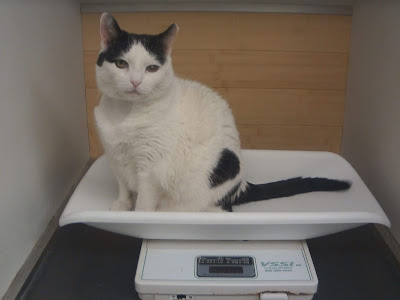
I remember a few years ago, David Letterman joked in his monologue that he saw an ad that said, “Lose weight without diet or exercise!” Well, said Letterman, “that pretty much just leaves disease”.
I see a lot of overweight and obese cats in my practice, and I’m always happy to see these cats shed some pounds. But last week, I saw two cats with dramatic weight loss, and I wasn’t all that happy about it. Why? Hint: it wasn't due to diet or exercise.
The first cat was Batman, owned by Ms. Catlubba (client's name has been changed). Ms. Catlubba is my longest active client. I took care of her cats when I was at the ASPCA. She found out that I started my own practice a few years later and tracked me down, so I’ve been caring for her cats for 14 years now. Her cat Batman used to be 20 pounds. Granted, that’s huge, but it’s not like he was a 20 pound cat in a 10 pound body. He was a 20 pound cat in a 16 pound body. At 20 lbs, he wasn’t grossly obese, but still, if I were him, I wouldn't wear a Speedo at the beach.
Dr. Arnold Plotnick (MS, DVM, ACVIM, ABVP) blogs about professional life experiences as an expert in the field of feline veterinary medicine. His feline-only full-service hospital, Manhattan Cat Specialists is located in the Upper West Side of New York City.
Monday, January 30, 2012
Holy Feline Diabetes Batman
Labels:
A week in the life,
Arnold Plotnick,
cats,
clients,
diabetes,
diagnosis,
hyperthyroidism,
Manhattan Cat Specialists,
patients
| Reactions: |
Friday, January 27, 2012
Corneal Ulcers in Cats
Anyone who has ever experienced having an eyelash trapped under a contact lens or a grain of sand blown into their eye quickly discovers that the cornea is loaded with pain receptors. A corneal ulcer – a scratch or scrape involving the cornea – is a relatively common, potentially vision-threatening disease of the cornea in cats.
Cornea 101 – the basics
The cornea is the clear membrane that covers the surface of the eyeball. Anatomically, it is composed of several layers. The outer surface layer is called the epithelium. Just beneath the epithelium is the stroma. The innermost layer is called Descemet’s membrane.
“All cat breeds are potentially at risk of developing corneal ulcers”, warns Dr. Chris Pirie, a board-certified veterinary ophthalmologist at the Cummings School of Veterinary Medicine at Tufts University. However, cats in general have pretty refined defense mechanisms to prevent damage to their corneas. They have vibrissae (specialized “whiskers” above their upper eyelids) that can detect objects that approach their eyes, allowing them to take evasive action. They also have a well-developed blink response. Attached to the back of the eyeball is a muscle called the retractor bulbi muscle. When this muscle contracts, the eyeball is pulled back into the socket. This retraction of the eye allows the nictitating membrane – sometimes called the “third eyelid” – to elevate, protecting the cornea. Despite these sophisticated mechanisms, cats will occasionally suffer trauma to the cornea, and an erosion occurs on the corneal surface. If the erosion goes through the entire epithelium into the stroma, this erosion is called a corneal ulcer. If the ulcer goes deep into the stroma all the way down to Descemet’s membrane, the condition is called a descemetocele (pronounced “dess-a-met-a-seal”). If the ulcer goes deeper, through Descemet’s membrane, the fluid inside the eyeball flows out and the eye collapses.
Cornea 101 – the basics
The cornea is the clear membrane that covers the surface of the eyeball. Anatomically, it is composed of several layers. The outer surface layer is called the epithelium. Just beneath the epithelium is the stroma. The innermost layer is called Descemet’s membrane.
“All cat breeds are potentially at risk of developing corneal ulcers”, warns Dr. Chris Pirie, a board-certified veterinary ophthalmologist at the Cummings School of Veterinary Medicine at Tufts University. However, cats in general have pretty refined defense mechanisms to prevent damage to their corneas. They have vibrissae (specialized “whiskers” above their upper eyelids) that can detect objects that approach their eyes, allowing them to take evasive action. They also have a well-developed blink response. Attached to the back of the eyeball is a muscle called the retractor bulbi muscle. When this muscle contracts, the eyeball is pulled back into the socket. This retraction of the eye allows the nictitating membrane – sometimes called the “third eyelid” – to elevate, protecting the cornea. Despite these sophisticated mechanisms, cats will occasionally suffer trauma to the cornea, and an erosion occurs on the corneal surface. If the erosion goes through the entire epithelium into the stroma, this erosion is called a corneal ulcer. If the ulcer goes deep into the stroma all the way down to Descemet’s membrane, the condition is called a descemetocele (pronounced “dess-a-met-a-seal”). If the ulcer goes deeper, through Descemet’s membrane, the fluid inside the eyeball flows out and the eye collapses.
Labels:
articles,
cats,
cornea,
corneal ulcer,
eyes,
Ulcerative Keratitis,
ulcers
| Reactions: |
Wednesday, January 18, 2012
Pocket of Fluid on Leg
A quick scan of my appointment schedule on any given day reveals a litany of the typical problems encountered by pet cats. Interspersed with the well-pet and update-the-vaccinations exams you’ll find “vomiting”, “diarrhea”, “urinating on the rug”, “runny eyes”, “losing weight”… the list goes on. It’s not often I see “pocket of fluid on leg”, so I was particularly curious about this one.
(Please note, what follows is semi-graphic material (no pictures, just written experience). Proceed with cation if blood, pus, and ooze makes you queasy. If you just chuckled at "blood, pus, and ooze," then you'll be fine.)
Labels:
A week in the life,
Arnold Plotnick,
cats,
clients,
digital x-ray,
leg,
Manhattan Cat Specialists,
mass,
patients
| Reactions: |
Tuesday, January 17, 2012
Adopt Rufus the Cat - Manhattan Cat Specialists Cat for Adoption
Rufus was abandoned by a family that moved away. Left outside to fend for himself he was found by a member of our staff.
He's about a year old, he's neutered, tested negative for FelV/FIV and he is up to date with all his vaccinations. He can only be adopted into a home that curently does not have cats. If you are interested in adoptiong Rufus please visit our “Adoption Corner.” Additionally, you may want to fill out our Pre-Adoption Application.
Please Recommend our adoption program to your friends by sharing this info.
http://manhattancats.com
Labels:
adoption,
cat rescue,
cats,
Manhattan Cat Specialists
| Reactions: |
Sunday, January 15, 2012
Top 10 Most-Read Cat Stories on CatChannel in 2011
Top 10 Cat Stories of 2011 on CatChannel
Visitors to CatChannel.com found the following 10 articles most interesting in 2011.
10. Loose StoolFind out what a vet recommends for dealing with loose stool. Click to continue
9. Cat Dandruff
Find out what causes dry, flaky skin in cats. Click to continue
8. Does Your Cat Have a Fever?
A vet explains how to recognize a feline fever and take a cat's temperature. Click to continue
7. Is Your Cat Depressed?
This checklist will help you find out. Click to continue
6. Do Cats Get Lonely If Left Home Alone All Day?
CatChannel behavior expert Marilyn Krieger, CCBC, explains why interaction with humans and animals is essential in a cat’s world. Click to continue
5. Why Does My Cat Drink Lots of Water?
Find out what a vet recommends for a cat who drinks excessive amounts of water. Click to continue
4. How Old Is My Cat in Human Years?
CatChannel veterinary expert, Arnold Plotnick, DVM, provides a chart for estimating a cat's age as it compares to a person's age. Click to continue
3. Should a Cat's Nose Be Wet or Dry?
CatChannel veterinary expert, Arnold Plotnick, DVM, says the notion that a cat's nose must be wet is not entirely accurate. Click to continue
2. Are All Orange Tabby Cats Male and Are All Calico Cats Female?
CatChannel veterinary expert, Arnold Plotnick, DVM, explains how cats get their gender and colors. Click to continue
1. Why Does My Cat Throw Up After Eating?
CatChannel veterinary expert, Arnold Plotnick, DVM, explains the possible causes for frequent vomiting in cats. Click to continue
---
|
Dr. Arnold Plotnick, DVM |
| Warm greetings to my fellow feline enthusiasts. I'm Dr. Arnold Plotnick, one of CatChannel's health experts. I am the owner of Manhattan Cat Specialists, a cats-only veterinary hospital in New York City, and I maintain a blog called Cat Man Do. I'm very excited that I've been given this opportunity to answer your cat questions and share my experiences as a practicing feline veterinarian. |
Labels:
Answers,
Arnold Plotnick,
articles,
CatChannel.com,
Questions
| Reactions: |
Announcing Manhattan Cat Specialists' First Retirement
Manhattan Cat Specialists is a relatively young hospital. We opened in January 2003, so we’re 9 years
old.
And yet, we’re ready to announce
our first retirement.
Labels:
Aging Cats,
cats,
Manhattan Cat Specialists,
pets,
Topeka
| Reactions: |
Friday, January 13, 2012
The Most Popular Cat Names of 2011
Labels:
Arnold Plotnick,
cats,
kittens,
Manhattan Cat Specialists,
names,
pet owners,
pets
| Reactions: |
Thursday, January 12, 2012
Your Cat's Kidneys.... and the Metric System.
Two days ago, my last appointment of the day was a new
client with her cat, George. The appointment
book said that the cat had chronic renal failure (CRF).
The
client arrived at 5:30 p.m. She had a copy of the records from her
previous
veterinary visits. It was a sizable stack, but leafing through it, I
finally found some bloodwork results. I recognized the format of the
bloodwork as
the kind that was performed on an in-house machine. I admit to having
some bias when I see these type
of reports, because although they’re likely accurate, I always feel that
they
are inferior to bloodwork performed by a well-known, well-established
reference laboratory. Regardless, I looked at the results and
noticed that the reference range for some of the parameters were odd. I
looked at the top of the page, and quickly
discovered why: the bloodwork was performed in the United Kingdom! I
then looked at the next line on the
report, where they list the cat’s age, weight and color. George was
only 1 ½ years old!
Labels:
A week in the life,
Arnold Plotnick,
blood urea nitrogen (BUN),
cats,
chronic renal failure,
clients,
diagnosis,
kidney,
Manhattan Cat Specialists,
patients
| Reactions: |
A Week in the Life of a New York City Cat Veterinarian in the Trenches
A new year has begun, and along with the new year comes the
resolutions. I try to be realistic with
mine, and make them not too unreasonable to achieve. This year, the list was pretty
realistic: spend more time with my
sister; read at least one book a month; stay below 170 lbs; and write more blog
posts.
Finding the topics to
blog about isn’t that difficult when you work in a New York City cat practice. Every day, I encounter interesting people, notable
cats, and intriguing medical conditions, all of which provide excellent blog
fodder. Turning them into blog posts,
however… that’s the challenge. So I’ve decided to start a new weekly feature on the
blog where
I discuss actual cases that come in the door, to give a realistic view of the
kind of things I encounter in a busy
Manhattan cat practice.
The cat names are real.
The client names have been changed.
Labels:
A week in the life,
Arnold Plotnick,
cats,
clients,
interesting cases,
Manhattan Cat Specialists,
New York City,
patients
| Reactions: |
Tuesday, December 27, 2011
Hypercalcemia in Cats
Hypercalcemia
Calcium plays an essential role in maintaining a healthy body in humans and animals. Too much of a good thing, however, can be dangerous, and this is definitely true for calcium. Discovering an elevated serum calcium level in cats is a fairly common finding in veterinary medicine. A variety of treatments are available that will readily bring an elevated calcium back into the normal range, but treating with medication should not be the primary approach. Because the most effective treatment is to address the underlying cause, our initial approach to hypercalcemia (elevated serum calcium) is to search for the origin. Once we find the cause (or should I say if we find the cause, because sometimes it can be tricky), we can prescribe the proper treatment.
by Arnold Plotnick MS, DVM, ACVIM, ABVP
Calcium is an essential nutrient, however, excessive blood levels can have serious consequences. Catnip’s medical editor explains the causes of – and concerns about – too much calciumCalcium plays an essential role in maintaining a healthy body in humans and animals. Too much of a good thing, however, can be dangerous, and this is definitely true for calcium. Discovering an elevated serum calcium level in cats is a fairly common finding in veterinary medicine. A variety of treatments are available that will readily bring an elevated calcium back into the normal range, but treating with medication should not be the primary approach. Because the most effective treatment is to address the underlying cause, our initial approach to hypercalcemia (elevated serum calcium) is to search for the origin. Once we find the cause (or should I say if we find the cause, because sometimes it can be tricky), we can prescribe the proper treatment.
Labels:
Arnold Plotnick,
articles,
bladdar stones,
calcium,
cats,
Hypercalcemia,
kidney,
parathyroid hormone,
urine
| Reactions: |
Subscribe to:
Posts (Atom)